

 IT
IT  DE
DE 
Cystitis in menopause represents a fairly common problem. If you have previously suffered from recurrent cystitis, menopause could worsen your condition.
The Dada Protocol can help you combat and prevent cystitis in menopause
Discover Puroman pure D-mannose and all the other products partnered with Cistite.info to tackle cystitis and prevent relapses! By becoming a member, you can also receive discounted prices on products and medical consultations
- Causes of cystitis in menopause
- Post-coital cystitis in menopause
- Prevention of cystitis in menopause
- Prevention of cystitis in menopause after intercourse
Causes
What are the main causes of cystitis in menopause?
The causes that contribute to worsening cystitis episodes and making them more frequent in menopause are numerous. Let’s look at them all:
- Increased pH
The lack of oestrogens alters the vaginal ecosystem, raising the pH, which can go from 3.5/4.5 up to 8. This hinders the survival of lactobacilli (the good bacteria that protect us from those capable of causing infection), whose ideal environment is acidic. - Genital atrophy
Due to the decrease in oestrogens, the vulvar mucosa atrophies, weakens, and becomes more prone to genital inflammations, which make the mucosa an ideal reservoir for pathogens that can then spread to nearby structures, causing urethritis and cystitis. - Urethral fragility
As the female genital tract shares the same embryonic origin as the lower urinary tract (urethra, trigone, and bladder), the latter is also influenced by hormones and experiences the consequences of decreased oestrogens. The urethral meatus thus becomes more fragile and more prominent in the vulva, making it more prone to trauma and contamination, resulting in symptoms such as urgency, frequency, dysuria, infections, stress or urge incontinence, tenesmus, nocturia, and weak urine flow. - Reduction of vaginal secretions
Hormonal changes also reduce vaginal secretions, which play a crucial role in protecting us from genital and urinary infections: they contain lactobacilli, defensive substances, nutrients for the mucosa, and lubricate the vaginal canal during intercourse, protecting the vaginal and urethral mucosa from trauma caused by penetration. - Pelvic floor relaxation
Childbirth and oestrogen deficiency lead to excessive relaxation of the pelvic floor and possible bladder prolapse (cystocele), which can result in incomplete bladder emptying and therefore urine stagnation. The longer urine remains in the bladder, the more time bacteria have to multiply, adhere to the bladder walls, and cause cystitis. In cases of pelvic pain, however, the opposite can also occur: the muscles may contract excessively and for prolonged periods, causing a pelvic contracture that compresses the urethra, vagina, rectum, blood vessels, and nerves, leading to pelvic organ distress, fragility, and vulnerability to infections. - Constipation
Constipation, which often occurs in menopause (due to poor hydration, reduced physical activity, and slowed intestinal peristalsis), also causes stool retention, which increases in size within the rectal ampulla and becomes very hard, compressing the pudendal nerve that runs alongside the rectal canal. This nerve is responsible for the innervation of the genital and urinary organs, and therefore for the nerve signals transmitted from the brain to these organs and from these organs to the brain. Impairment of the pudendal nerve disrupts these nerve signals, causing symptoms similar to vaginal infections and cystitis even in the absence of a real bacterial attack. - Decline in immune defenses
In menopause, there is also a decline in both local and systemic immune defenses, which promotes the onset of cystitis.
Prevention
How can cystitis be prevented in menopause?
Considering the triggering factors described above, to prevent and treat cystitis in menopause you need to work on two fronts: urinary and genital. Here are some strategies that will help you prevent cystitis episodes:
- Take D-mannose regularly
The intake of D-mannose is the primary aid as it prevents bacteria from attaching to the bladder, and in this way not only prevents the onset of bacterial cystitis but also provides valuable support in eliminating acute episodes.
Further information: D-mannose against cystitis
- Acidify the vaginal environment and introduce lactobacilli
The lactobacilli will allow you to counter the proliferation of pathogenic bacteria, and the acidification will create an environment with a physiological pH in which the lactobacilli can survive better. For this purpose, we have selected some products that have proven to be highly tolerated even by women with extremely high vulvar hypersensitivity: Calagyn, Ginocanesbalance, Acidif CV, and Vitagyn C.
Further information: Vaginal lactobacilli
- Oestrogens
The administration of oestrogens improves the health of the urethral, bladder, and vaginal mucosa, thereby reducing incontinence, local hypersensitivity, and the severity of urinary symptoms. As the bladder has exclusively beta-type oestrogen receptors, and the urethra also predominantly has them, only the administration of oestrogens active on beta receptors can be effective (0.5% estriol cream), whereas therapies based on estradiol (primarily active on alpha receptors) or synthetic oestrogens will not provide any urinary benefit.
Estriol applied vaginally also normalises the vaginal environment, pH, and the number of lactobacilli, thus reducing the vaginal bacterial reservoir and consequently the risk of bladder infection. Initial results are visible after three months of application.
Alternatively, oestrogen deficiencies can be compensated with food (soy, hops), natural plants useful in menopause, herbal teas (chasteberry, black cohosh, red clover), and specific dietary supplements (Red Clover 80).
Further information: Bioidentical hormones
- Strengthen the genital mucosa
Through the experiences shared on the forum over the years, our association has collected many testimonies on various local treatments useful in menopause. By analysing the results obtained, we have formulated a protocol based on products and natural remedies that have so far shown the best balance between benefit and genital irritative effects. The protocol is named after the woman who first tried the recommended sequence of products: Dada.
Further information: The Dada protocol
- Strengthen bladder defenses
It is essential to reinforce urinary defenses by repairing and strengthening the inflamed bladder and urethral mucosa through the intake of GAGs. For this purpose, our association has had Purorepair GAG Plus specially produced, a natural product to reduce inflammation and repair the connective tissues of the urinary tract.
Further information: What GAGs are
- Train the pelvic floor
Exercising with Kegel exercises and a perineal rehabilitation programme can improve bladder continence and proper emptying. In cases of contracture, you can perform reverse Kegels and vaginal self-massage independently, but I initially recommend consulting a physiotherapist experienced in pelvic rehabilitation, who can teach you these exercises correctly.
Further information: Vaginal self-massage to relax the muscles
- Immunostimulants
It is essential to strengthen general defenses with immunostimulant products (Purodefend), regular physical activity, and a healthy diet rich in fruit and vegetables. - Resolve constipation
Address constipation by drinking plenty of fluids, engaging in regular physical activity, and supplementing your diet with fibre through fruit and vegetables or highly specific products.
- Eliminate triggering factors
There can be various factors that trigger cystitis, and they may differ for each woman. It is necessary to identify your own in order to prevent and control them.
Further information: The triggering factors of cystitis
In case of cystitis, follow our advice:
How to combat acute cystitis
Tips to prevent cystitis
Thanks to many years of experience, our association has developed a treatment and prevention plan that can help you manage the complete care of cystitis in menopause and strengthen genital defenses to prevent possible relapses.
Receive our Dada Protocol for cystitis in menopause for free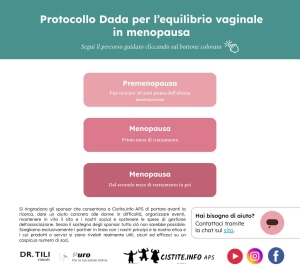
Post-coital cystitis in menopause
Does menopause promote the onset of cystitis after intercourse?
 Very often in menopause, cystitis is triggered after sexual intercourse.
This happens for several reasons related to this stage of a woman’s life. The decrease in oestrogens that occurs during menopause causes atrophy of the genital mucosa, resulting in the labia majora losing plumpness, the labia minora becoming thinner, pubic hair decreasing and weakening, the vaginal mucosa becoming fragile and thin, the vaginal opening narrowing, the number of blood vessels reducing, vaginal lubrication decreasing, and the urethral mucosa thinning and beginning to protrude from the urethral canal.
All of this leads to microtraumas of the urogenital mucosa during sexual intercourse.
These small abrasions cause the woman to experience pain during penetration. The pain immediately suppresses arousal.
During arousal, there is a blood flow (called congestion) to the female genital organs, just as occurs in men. As the blood vessels fill with blood, they form a kind of cushioning sleeve around the urethra, protecting it from the impacts of sexual intercourse. Lack of arousal prevents this blood flow and therefore the formation of the cushioning sleeve around the urethra, which, thinned by oestrogen deficiency, is prone to microtraumas during intercourse.
As an automatic reaction to pain, the woman contracts the pelvic muscles, further narrowing the vaginal opening and increasing friction and perceived pain.
Often, these vulvar, vaginal, and urethral microtraumas alone are enough to cause symptoms similar to cystitis or yeast infection, even in the absence of bacterial or fungal infection (which is mistakenly treated with antibiotics or antifungals). In such cases, the pain appears in the hours immediately following intercourse.
Microabrasions on the mucosa represent an entry point for bacteria, which use these openings to reach the deeper, more immature cells that are less capable of defending themselves. In these microlesions, bacteria reproduce undisturbed and from there begin to invade nearby organs (such as the urethra and, subsequently, the bladder). For bacteria to reproduce and carry out this invasive process, they need sufficient time, which is why true post-coital bacterial cystitis arises 24–72 hours after intercourse.
Further information: Post-coital cystitis
Prevention of post-coital cystitis in menopause
How can cystitis in menopause be prevented after intercourse?
To prevent these issues, it will be useful to follow these tips:
- Apply natural bioidentical oestrogen (estriol) directly to the vagina and/or vulva to progressively improve the nourishment of the genital and urethral mucosa. Initial results are visible after three months of application.
- Use a lubricant based on D-mannose and hyaluronic acid during intercourse to reduce friction and prevent new microlesions.
- Strengthen the genital mucosa with emollient, hydrating, and re-epithelialising products (Vitamin E spray, Tiobec, allantoin, panthenol, almond oil, coconut oil, etc.).
- Compensate for oestrogen deficiencies with food (soy, hops), natural herbal teas (chasteberry, black cohosh, red clover), and/or specific supplements for menopause (Red Clover 80).
- Relax the pelvic muscles with self-massage and reverse Kegel exercises
- Strengthen the bladder mucosa through the intake of GAGs.
- Prevent post-coital cystitis by taking D-mannose immediately after intercourse and three more times within the following 24 hours (one dose approximately every 8 hours).
Further information: Other causes of cystitis in menopause
Bibliography
- "Silenzio intimo" Piancone R., Lulu 2012
- Graziottin, “Menopausa precoce: dal dolore alla salute”, Atti e approfondimenti di farmacologia, Milano, 27 marzo 2015, Fondazione Alessandra Graziottin.
- “Menopausa felice”. Christiane Northrup Urra 2006
- "Effects of conjugated equine estrogen in ostmenopausal women with hysterectomy" The Women’s Health Initiative randomized controlled trial. JAMA 2004;291: 1701-12.
- "Risks and benefits of estrogen plus progestin in healthy postmenopausal women: principal results from the Women’s Health Iniziative randomised controlled trial. Writing Group for the Women’s Health Iniziative Investigators". JAMA 2002; 288: 321-33.
- “Menopausa: vivere bene il cambiamento”, Canino, Vozzella, Diunti Demetra 2016.
- Graziottin A. "Il dolore segreto. Le cause e le terapie del dolore femminile durante i rapporti sessuali". Arnoldo Mondadori Editore, Milano, 2005
- Barrett G, Pendry E, Peacock J, Thakar R, Maymonda I." Women’s sexual health after childbirth". BJOG 197: 186-95; 2000
- Glazener C. "Sexual function after childbirth: women’s experiences, persistent morbidity and lack of professional recognition". BJOG 104: 330-5; 1997
- Guaschino S, Benvenuti C; SOPHY Study Group "SOPHY project: an observational study of vaginal pH and lifestyle in women of different ages and in different physiopathological conditions. Part I. Minerva Ginecol. 60(2):105-14; 2008
- "Preventing urinary tract infections after menopause without antibiotics." Caretto M, Giannini A, Russo E, Simoncini T. Maturitas. 2017 May;99:43-46.
- "An Investigation of Lower Urinary Tract Symptoms in Women Aged 40 and Over." Sever N, Oskay U. Low Urin Tract Symptoms. 2017 Jan;9(1):21-26.
- "Evaluation of the urinary microbiota of women with uncomplicated stress urinary incontinence." Thomas-White KJ, Kliethermes S, Rickey L, Lukacz ES, Richter HE, Moalli P, Zimmern P, Norton P, Kusek JW, Wolfe AJ, Brubaker L; National Institute of Diabetes and Digestive and Kidney Diseases Urinary Incontinence Treatment Network. Am J Obstet Gynecol. 2017 Jan;216(1):55.e1-55.e16.
- "Probiotics [LGG-BB12 or RC14-GR1] versus placebo as prophylaxis for urinary tract infection in persons with spinal cord injury [ProSCIUTTU]: a study protocol for a randomised controlled trial." Lee BB, Toh SL, Ryan S, Simpson JM, Clezy K, Bossa L, Rice SA, Marial O, Weber G, Kaur J, Boswell-Ruys C, Goodall S, Middleton J, Tudehope M, Kotsiou G. BMC Urol. 2016 Apr 16;16:18.