

 IT
IT  DE
DE 
Chronic or recurrent Cystitis is a form of Cystitis (usually bacterial) that recurs 3–6 times over the course of a year.
The traditional treatment of Cystitis is based on antibiotic therapy. However, antibiotics not only destroy pathogenic bacteria but also beneficial bacteria that help strengthen the immune system. This only increases the likelihood of recurrences and Candida infections, since antibiotics are not effective against fungi, which remain the only survivors of the therapy and are therefore able to reproduce unhindered.
A more effective approach must instead restore the body’s lost defenses and balances, and focus on multiple aspects of the organism in order to definitively break the vicious cycle that has become established.
To help you manage the triggering factors of chronic Cystitis and restore your defenses, we have summarized what you can do in a practical scheme.
In-depth: Antibiotics
Receive the chronic Cystitis treatment plan for free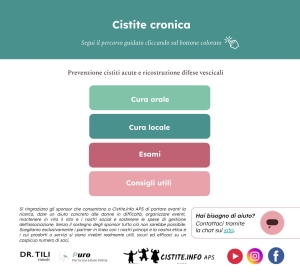
Discover Puroman pure D-mannose and all the other products partnered with Cistite.info to tackle Cystitis and prevent recurrences!
Once the acute episode has been eradicated (read the Guidelines for acute Cystitis), it will be essential to adopt a series of natural remedies to reduce the likelihood of recurrence. Below you will find a list of useful tips to strengthen your defenses and reduce risk factors:
- Treatment with D-mannose
- Pelvic floor muscles
- GAG therapy
- Vaginal lubricant
- Treatment with natural antibiotics
- Constipation
- Urinate frequently
- Bacterial flora
- Hydration
- Intimate cleansers
- Healthy diet
- Genital mucosa
- Alkalinization
Treatment of chronic Cystitis with D-mannose
How should D-mannose be taken to prevent recurrent Cystitis?
D-mannose is a sugar extracted from the bark of hardwood trees (birch) that binds to the “legs” of bacteria, preventing them from attaching to the bladder walls. These bacteria, free and floating in the urine, are then eliminated with the urinary flow. Without adhesion to the bladder, bacteria cannot trigger inflammation. Without inflammation there is no bladder damage, and without bladder damage there are no symptoms. In this case, cystitis turns into asymptomatic bacteriuria, which, being harmless, does not need to be treated.
Taking D-mannose regularly, even outside acute phases, makes potentially pathogenic bacteria harmless and facilitates their constant elimination. We recommend taking 3 grams per day of pure D-mannose for the first month, then gradually reducing the dose as symptoms improve.
Our association, thanks to twenty years of experience working closely with thousands of women, has had a very pure mannose (Puroman) specially produced for urinary conditions, free from potentially harmful substances such as:
- heavy metals
- pesticides
- preservatives
- sweeteners
- flavorings
Puroman can be purchased at discounted prices for members. We have created effective treatment plans, available for free download, for treating chronic Cystitis, in which you can find information on how to take it.
Pure D-mannose can also be given to children and to pregnant women.
In-depth look: What is D-mannose
Restoring the GAG layer
How can the bladder wall be strengthened to prevent recurrent Cystitis?
The cells of the bladder wall are covered by GAGs (GlycosAminoGlycans), which make it impermeable and impenetrable, protecting the underlying cellular layers (which are more fragile, immature, and sensitive) from the aggression of urinary acidity, bacteria, and irritating substances present in the urine. Repeated episodes of Cystitis alter this layer, causing the bladder to lose this important defense. It therefore becomes necessary to restore the GAG layer with specific supplements in order to make the bladder less vulnerable and bacteria more harmless.
We recommend taking supplements based on low–molecular weight hyaluronic acid (recognizable in the ingredients list as “hydrolyzed hyaluronic acid”), which is much more easily absorbed and therefore more effective.
In-depth look: GAGs (GlycosAminoGlycans)
Natural antibiotics
Which natural antibiotics can be taken to prevent recurrent Cystitis?
Until your defenses are restored, it can be useful to protect your bladder from possible bacterial attacks through the use of a natural antimicrobial. There are several natural substances with strong antimicrobial activity:
- garlic
- turmeric
- pepper
- bromelain
- lactoferrin
Our association has had Purodefend Urto specially produced for people who suffer from cystitis. It is composed of:
- apolactoferrin (a protein found in breast milk, which protects newborns from infections)
- NAC (N-aceylcysteine, which dissolves bacterial biofilms, i.e. the shields that Candida and bacteria create to protect themselves from antibiotics and antibodies)
- turmeric (with anti-inflammatory, antibiotic, and pain-relieving effects)
- pipenig (rich in caryophyllenes, which act on endocannabinoid receptors, relieving pain like cannabis but without psychoactive effects)
- bromelain (anti-inflammatory)
- echinacea (to stimulate the immune system)
We recommend taking 2 capsules per day for the first month, then gradually reducing the dose as symptoms disappear.
Urinate frequently
How bacterial stagnation in the bladder be avoided?
The longer urine containing bacteria remains stagnant in the bladder, the more time those bacteria have to multiply and adhere to the bladder walls, causing further episodes of Cystitis. It is therefore important to urinate regularly at not overly long intervals (every 3–4 hours) to avoid this stagnation.
Hydration
Can staying hydrated prevent new episodes of Cystitis?
Drinking to flush the bladder is essential, as it prevents bacteria from stagnating in the bladder. Bladder flushing is done by drinking small amounts frequently (about 50 ml of water every 15–20 minutes, for a total of 2 to 2.5 liters per day). Continuous bladder flushing should be carried out not only during the acute phase, but also outside of it to prevent recurrences, preferably using an herbal tea made of mallow, couch grass, and horsetail plus D-mannose.
Healthy diet
How can chronic or recurrent Cystitis be prevented through diet?
A healthy diet will help you reduce overall inflammation and therefore also bladder inflammation. In addition to reducing sugars, carbohydrates, refined foods, and processed foods, it is important to consume plenty of alkalizing foods, reduce acidifying ones, and avoid foods rich in oxalates. To understand which foods worsen symptoms, read the in-depth section.
In-depth look: Diet in 6 points
Alkalinizing the urine
How can urine be alkalinized to prevent damage to the GAG layer?
An acidic solution passing over an inflamed surface irritates it even further, causing additional damage to the GAG layer already compromised by repeated recurrences. Alkalinization also prevents oxalates from aggregating and forming crystals (which irritate the mucosa) or stones. On the market you can find effective alkalinizing products:
- Regobasic
- Basentabs
- basenpulver or simply sodium bicarbonate
In-depth look: How to easily alkalinize the urine
Relaxing contracted pelvic floor muscles
How can pelvic floor muscles be relaxed to prevent chronic or recurrent cystitis?
The pelvic floor is a group of muscles through which the urethra and the nerves that regulate bladder actions and sensations also pass. If these muscles are contracted, the urethra remains closed, preventing the bladder from emptying completely; moreover, all the sensory signals coming from the bladder and the motor signals directed to the bladder become disrupted.
It is possible to treat pelvic muscle contraction on your own at home, but it is still advisable to consult a qualified professional, who can teach you how to perform the various exercises correctly and carry out more specific treatments. Magnesium taken orally helps promote muscle relaxation (for example Supreme Magnesium), as does the application of magnesium spray to the lower abdomen.
In-depth look: How to relax the pelvic floor muscles
Vaginal lubricant
How can lubrication prevent episodes of Cystitis?
During sexual intercourse, we recommend always using a vaginal lubricant if you suffer from post-coital cystitis (or “honeymoon cystitis”). This reduces friction and microlesions, giving bacteria fewer opportunities to proliferate in the vagina and cause recurrent or chronic cystitis. However, many products on the market are very irritating to delicate mucous membranes. There are creams specifically designed to soothe, hydrate, and help heal the genital mucosa.
Discover the lubricant recommended by the association
Constipation and chronic or recurrent cystitis
Can fecal stagnation lead to new episodes of Cystitis?
Fecal stagnation in the rectal ampulla increases the size of the stool and makes it very hard. Large, hard stools can compress the pudendal nerve, which runs parallel to the rectal canal. The pudendal nerve innervates the genital organs and the bladder: its compression will cause symptoms similar to urinary tract infections and vaginal infections. It is therefore important to regulate bowel function and rebalance the bacterial flora with:
- probiotics (Nutriflor, X-Flor, Flormidabil, VSL#3)
- a fiber-rich diet
- adequate hydration
- daily physical activity
Read the constipation protocol on our forum (in Italian)
Vaginal bacterial flora
Does a healthy bacterial flora help prevent chronic or recurrent Cystitis?
To prevent chronic or recurrent cystitis, it is essential to restore the vaginal bacterial flora through the vaginal administration of lactobacilli (Gynocanesflor or Normogyn are the most well tolerated) or, more simply, natural whole yogurt with no added sugars (read, in Italian, on the forum how to apply it). Over the years, to restore the vaginal bacterial flora, we have developed a highly well-tolerated protocol composed of natural products. To avoid cytolysis (an excess of lactobacilli), before introducing lactic ferments make sure you are deficient by using vaginal pH evaluation strips.
Receive the Miriam protocol for restoring vaginal bacterial flora for free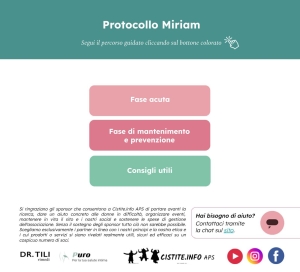
Learn more about the Miriam protocol to restore your vaginal bacterial flora
Intimate cleansers
Do cleansers promote new episodes of Cystitis?
Which ones should you choose?
We recommend using intimate cleansers only to clean the anal area after defecation, preferring plain water for daily genital hygiene. Cleansers, even the most delicate ones, alter vaginal pH, putting the survival of beneficial bacterial flora at risk. In addition, the surfactants contained in cleansers mechanically remove both the remaining bacterial flora and the very important vaginal secretions rich in antibacterial substances. Eliminating these elements removes an important defense that, if present, would prevent bacteria from passing from the anus to the bladder.
Use intimate cleansers on the genitals only after sexual intercourse and during menstruation, preferring a cleanser based on D-mannose and with a physiological pH.
Read the testimonials of those who have stopped using intimate cleansers (in Italian)
Genital mucosa
How to protect the genital mucosa?
To solve the problem of recurrent cystitis, it is also necessary to strengthen the genital tissue so that it does not become a bacterial reservoir. To do this, everything that is potentially irritating must be eliminated:
- synthetic sanitary pads and panty liners (replace them with washable or disposable cotton ones or with a menstrual cup)
- thongs
- synthetic and colored underwear
- tight trousers or trousers with a tight crotch
- estro-progestin hormonal therapies (pill, patch, IUD, ring, etc.), preferring natural contraceptive methods (condom, symptothermal method, etc.)
To strengthen the genital mucosa, you can apply emollient and soothing creams (Puronerv oleogel, vitamin E spray, Vea oil, Panthenol 5% among the most well tolerated).
In-depth look: Behavioral advice in cases of vulvar fragility