

 IT
IT  DE
DE 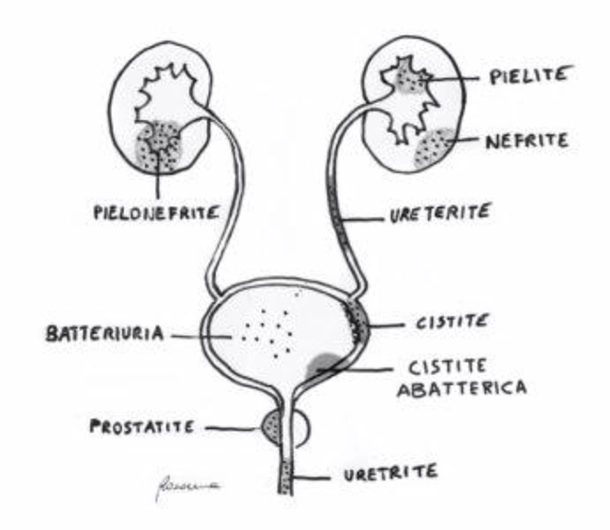
Asymptomatic bacteriuria is a bladder condition characterised by the presence of bacteria in the urine (confirmed by urine culture) without the typical symptoms of cystitis. It is quite common during pregnancy, in childhood, in the elderly population, in diabetics, in incontinent individuals, in cases of urinary stones or tumours, and in users of urinary catheters, but it can also be readily detected in non-pregnant fertile women.
Further Reading: Symptoms of Cystitis
Asymptomatic Bacteriuria
What is Asymptomatic Bacteriuria?
Asymptomatic bacteriuria is a condition in which the presence of bacteria in the bladder does not cause any harm to the bladder. Therefore, there is no inflammation, and urine tests (or home urine dipsticks) will detect the presence of nitrites (an indicator of bacterial presence) and the absence of leucocytes or their minimal presence (an indicator of lack of inflammation). In such cases, it is very important to exclude that the presence of bacteria is due to contamination during urine sample collection or handling by healthcare personnel. To be certain, it is advisable to repeat the culture test five days after the previous one. If the bacterial load is lower than before and consists of different bacteria, this indicates contamination. If the same bacterium is involved and the load has increased, there is a possibility that symptoms may develop soon. If the same bacterium is detected in the same quantity, this indicates true asymptomatic bacteriuria, which is presumably harmless.
The urine may appear cloudy and malodorous, but painful symptoms are absent. The absence of symptoms despite the presence of bacteria may depend on several factors:
- Effective defences
Your body's defences are able to keep the infection under control, preventing microorganisms from colonising the walls of your bladder. As a result, you will have neither inflammation nor the symptoms associated with it. - Non-pathogenic bacteria
Another possible cause of asymptomatic presentation is related to the type of bacterium. It may lack pathogenic characteristics, meaning it is not capable of causing an infectious disease. For example, some bacteria do not have adhesive capabilities. Unable to attach to the bladder walls, they cannot expand their colony as they are expelled with the urinary flow before having sufficient time to replicate. They therefore have reproductive capacity (as asymptomatic bacteriuria persists over time) but lack adhesiveness and are thus non-pathogenic. - Neurological causes
A disorder or trauma affecting the central nervous system (brain and spinal cord) or the peripheral nervous system (nerves, nerve endings, and receptors) can alter bladder sensitivity by reducing or blocking pain signals. In this case, the pain is not absent, but it cannot be perceived; therefore, the absence of symptoms does not rule out the presence of inflammation or bacterial pathogenicity.
Treatment
Should asymptomatic bacteriuria be treated?
Many people who are asymptomatic discover they have bacteria in their urine only through routine tests and are then treated with antibiotics in a futile (and harmful) attempt to eliminate this bacterial load. In fact, one can carry asymptomatic bacteriuria for months, years, or even a lifetime without ever developing inflammation, symptoms, or damage.
Since there is no infection in this case, antibiotics are not necessary, and it is sufficient to monitor the situation and prevent the onset of a true bacterial cystitis, which is characterised by bladder inflammation and pain.
“In 2008, my partner and I decided to have a child. I went to speak with the gynaecologist, who gave me some tests to do, including urine tests. You can imagine what came up: E. coli 1,000,000, nitrites, mucopus, traces of blood PRESENT!!!! and immediately, antibiotics!!! I repeated this routine for about a year, going back and forth between the gynaecologist, my GP, and the urologist… all of them kept giving me antibiotics. I HAD NO SYMPTOMS AT ALL!!!”
Lalla74 30/11/2010 (cistite.info)
Below you can find the treatment protocol developed by the association together with the doctors we collaborate with, based on the experiences of thousands of women with whom our association has interacted daily for decades.
Receive the asymptomatic bacteriuria treatment protocol for free
Further Reading: How to Treat Asymptomatic Bacteriuria
Study on Asymptomatic Bacteriuria
Are there studies on asymptomatic bacteriuria?
A study published on 5 October 2000 in the New England Journal of Medicine evaluated 796 sexually active, non-pregnant women without cystitis problems or symptoms over six months. Over time, 5% of the women developed asymptomatic bacteriuria. Of these, only four developed symptomatic disease one week after the urine culture, while the remaining 36 remained asymptomatic.
An Italian study from 2011 followed 673 women with asymptomatic bacteriuria for 12 months.
Half of the women were treated with antibiotics, and half received no therapy. Ninety-eight women treated with antibiotics experienced recurrences, compared with 23 in the untreated group. Quality of life over the year of evaluation was significantly higher for the untreated women. Among the 673 women participating in the study, only three developed pyelonephritis: two in the antibiotic-treated group and one in the opposite group. An interesting note: this study was awarded in France at the 27th Annual Congress of the European Association of Urology (February 2012) as the best work in the urological field. In Italy, presented in 2011 at the national SIU (Italian Society of Urology) congress, it went largely unnoticed.
These studies highlight that our bodies are capable of defending against the bacteria present, that the progression from asymptomatic bacteriuria to symptomatic cystitis is unlikely, and that progression to pyelonephritis is even rarer. Furthermore, these studies show that antibiotic therapy is not recommended, not only because it is unnecessary (there is, in fact, no real threat to combat), but especially because it is harmful: it can create resistance, disrupt the vaginal and intestinal bacterial flora (which protects us from bacterial attacks), and increase the risk of bladder contamination by truly pathogenic bacteria.
Consequently, asymptomatic bacteriuria should not be treated (under the risk of triggering a true symptomatic cystitis) except in particular cases, such as kidney transplantation.
“Once, among various tests, I did a urine culture, but no one told me that I had to discard the first stream of urine or that I needed to use a bidet before collecting the sample. The result came back positive for E. coli, and I took antibiotics. Then another urine culture, more antibiotics, all without any symptoms!
well, after the second course of antibiotics, the cystitis actually started. From then on, I had cystitis for ten months, one month yes, one month no.”
Yaya 13/09/2012 (cistite.info)
The Merck Manual for Healthcare Professionals states:
“In untreated asymptomatic bacteriuria, the microorganisms (especially Escherichia coli) lose their virulence and become extremely sensitive to the bactericidal effect of normal human plasma. The presence of large amounts of bacteria in the urine may, therefore, have a protective effect against symptomatic bacteriuria caused by more virulent microbial strains.”
The regular use of D-mannose helps to eliminate excessive bacterial loads and maintain these microorganisms in a harmless state.
“I’m not really sure how to describe my situation, in the sense that the bacteria are still present in my urine. I know this because I occasionally test with a dipstick and nitrites are present, but I don’t know how many bacteria there are since I haven’t done a urine culture for months. The last time it was 100,000—practically nothing compared with the 10,000,000 I had before taking the mannose.
As for the symptoms, they have completely disappeared for months now. (...)
I no longer have any problems with sexual activity and I eat everything. I go to the gym, to the pool (aquagym, unfortunately I can’t swim), and cycling, and I have no issues.
If I’m not cured, a cheerful coexistence has developed with my Escherichia coli. We live together without stepping on each other’s toes."
Silvana 12/10/2010 (cistite.info)
“I haven’t posted on this forum for ages, but not a day goes by that I’m not mentally grateful to it.
In April comes the anniversary of my liberation (not the 25th, but the 10th—the date of my last cystitis episode!). For three whole years, I have NEVER had any problems. I can be counted among the cured (the Escherichia haven’t gone away—I still have a few million, but zero leucocytes and I am asymptomatic). (…) I am a new woman, carefree, without any impairments!
Three wonderful years, and thank you all.”
Ross80 30/04/2013 (cistite.info)
Bibliography
- “Trattato di anatomia patologica clinica” M. Raso Vol II, Piccin, 1981, pag 371/379
- “Chirurgia. Basi teoriche e Chirurgia generale” R. Dionigi, Elsevier 2009, pag 1445
- “Patologia medica” AA. VV: Piccin, 1989,, pag 188
- “Malattie infettive” M. Moroni, R. Esposito, F. De Lalla, Elsevier Masson, 2008 pagg 634/637
- “Medicina interna sistematica” C. Rugarli, Elsevier 2010 , pag 917
- “Manuale di Chirurgia Generale” (2 voll.) G. Fegiz, D. Marrano, U. Ruberti , Piccin 1996, pag 2799
- “Infezioni delle vie urinarie” A. Bartoloni, Clinica di Malattie Infettive e Tropicali, Università degli Studi di Firenze
- “Il dosaggio della glicoproteina di Tamm-Horsfall: sfizio nefrologico o strumento diagnostico?” M. Marangella, M. Petrarulo, C. Bagnis, S. Berutti, C. Vitale, A. Ramello, UO Nefrologia Dialisi e Centro Calcolosi Renale, Ospedale Mauriziano Umberto I di Torino
- “Trattato di medicina interna” G. Crepaldi, A. Baritussio , Volume 3, Piccin, 2003, pagg 3605-3606
- “Tamm-Horsfall protein: a multilayered defence molecule against urinary tract infection” M.D. Säemann, T. Weichhart, W. H. Hörl, G. J. Zlabinger, Medical University of Vienna, Vienna, Austria.1, Eur J Clin Invest. 2005 Apr;35(4):227-35
- “Andrologia clinica” W. B. Schill, F. H. Comhaire, T. B. Hargreave, Springer 2010, pag 402
- “Valutazione del ruolo della batteriuria asintomatica nella prevenzione delle recidive sintomatiche nelle giovani donne affette da UTI ricorrenti...” F. Meacci, T. Cai, N. Mondaini, L. G. Luciani, D. Tiscione, G. Malossini, S. Mazzoli, R. Bartoletti, 84°congresso nazionale SIU, Roma 23-26 ottobre 2011
- Manuale Merck per medici (http://www.msd-italia.it/altre/geriatria/sez_12/sez12_100.html)