

 IT
IT  DE
DE 
Honeymoon cystitis, or post-coital cystitis, is a urinary tract infection that develops within 24 to 72 hours after sexual intercourse. It is caused by the mechanical trauma to the vulva, urethra, and vagina during intercourse. These microlesions lead to urethral and bladder pain (often described as “intimate burning”), urgency, frequency, a feeling of bladder pressure, and within a few days, full-blown Cystitis.
The post-coital Cystitis treatment plan helps you prevent and fight Cystitis after intercourse.
Discover Puroman Pure D-mannose and all the other products partnered with Cistite.info to tackle Cystitis and prevent recurrences!
Causes
What are the causes of post-coital Cystitis?
The causes of honeymoon Cystitis or post-coital Cystitis are, in most cases, insufficient lubrication and pelvic floor muscle contraction.
The contracted muscles narrow the vaginal opening, causing friction during penetration and resulting pain. The anticipatory fear of pain also prevents adequate lubrication and further tightens the muscles. All of this contributes to causing microtraumas to the vulvo-vaginal mucosa.
While on intact tissue (like the skin on an arm, for example) bacteria do not cause any harm, on damaged tissue (such as a wound on the same arm) bacteria can take hold and multiply because the cells beneath the tougher outer layer are very fragile and vulnerable. Similarly, in these genital microlesions, pathogens find refuge by colonizing the vagina. Their reproduction leads the bacteria to seek less crowded areas, so they invade the urinary tract by ascending along the vulva and urethra up to the bladder. This process takes several hours, which is why Cystitis does not occur immediately after intercourse but typically appears 24 to even 72 hours later.
In some cases, a woman may be incompatible with her partner’s sperm. This can cause an inflammatory reaction upon contact with male fluids, producing symptoms similar to those of Cystitis or Vaginitis. Using a condom prevents this reaction.
In other cases, however, it is the use of the condom itself that causes Cystitis. This can happen due to intolerance to the material the condom is made from, increased friction during intercourse, or excessive rubbing on the vulvar mucosa caused by the ring at the base of the penis. Thanks to research and data collection, our association has selected two condoms that are highly tolerated by women with extreme local sensitivity: Akuel Skin and Akuel Nudo.
Treatment and prevention
How is post-coital Cystitis treated with natural remedies?
How can post-coital Cystitis be prevented?
To treat and prevent honeymoon Cystitis, it’s important to address the problem from every angle with a few simple but essential tips. You can find these organized in the table below, created by our association based on over ten years of experience working closely with thousands of women.
Get the post-coital Cystitis treatment plan for free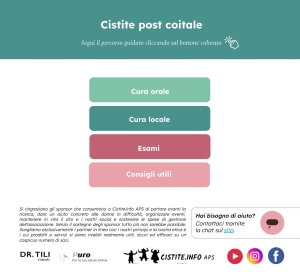
- Urinate before intercourse to have an empty bladder—making it less bulky and less exposed to trauma
- Increase foreplay to ensure abundant natural lubrication. Without sufficient lubrication, avoid intercourse, as this can create a vicious cycle: pain, inflammation, fear, tension, lack of lubrication, microlesions, and so on. A good alternative is using vaginal lubricants, but avoid those sold in supermarkets, as they are suitable for healthy tissue only. On delicate mucosa, they can cause irritation and worsen the situation. It’s better to use a lubricant based on D-mannose to help prevent infection even during intercourse.
- Before penetration, try to relax the pelvic muscles by performing 3 reverse Kegel exercises
- Always use a lubricant (such as Puroman Gel, Lubrigyn, or Natural Durex) to avoid friction on the mucous membranes
- Seek your partner’s cooperation: explain that you NEED to follow certain rules to improve your uro-genital health and, consequently, your sexual life. Stop immediately at the first sign of pain and try again the next day
- Urinate immediately after intercourse to flush out any bacteria that may have entered the urethra during sex
- After intercourse, wash with warm running water and a gentle intimate cleanser containing D-mannose (such as Puroman intimate wash)
- After the wash, apply a re-epithelializing cream to the vulva (such as Puronerv, Vitamin E spray, almond oil, Vea oil, or ointments containing allantoin or panthenol) to soothe the genital mucosa
- Take a dose of D-mannose immediately after intercourse, then 4 grams per day for the next 48 hours, reducing to 3 grams on the third day and 2 grams on the fourth day. This way, the D-mannose that reaches the bladder binds to the bacteria ascending the urinary tract. The bacteria attached to the sugar are then expelled with the urine flow. If 4 grams are not sufficient, increase the dose in subsequent occasions. How to take D-mannose
- Take a natural anti-inflammatory/antibacterial immediately after intercourse, then 3 capsules within the next 24 hours (with food), and 2 capsules on the second day after intercourse. If pain persists, continue with 3 capsules per day until symptoms disappear. Our association has specially produced Purodefend Urto, which has antibacterial, pain-relieving, and anti-inflammatory properties
- Drink at least two liters of water per day (mallow, couch grass, and horsetail herbal tea are excellent choices) in the 48 hours following intercourse
- Restore the bacterial flora damaged by repeated antibiotic and antifungal treatments with courses of oral and vaginal probiotics. Many women in our Forum consider the Miriam protocol a valuable aid for treating and preventing honeymoon Cystitis
- One of the causes of Cystitis is excessive hygiene: cleansers can alter the pH and mechanically remove the natural bacterial flora, which MUST be present on our mucous membranes to protect them from bacterial attack and invasion. Try avoiding intimate cleansers altogether (use a gentle cleanser only for the anus after defecation) for a week and see how much better you feel. Read experiences on the Forum from those who have stopped using intimate cleansers (in Italian). Also avoid internal tampons, panty liners, and synthetic pads, as they only irritate the vulvar and vaginal area
- Consider the possibility that you may suffer from pelvic floor hypertonicity, Vulvodynia, or pelvic neuropathies. In such cases, it would be helpful to consult an experienced professional recommended or affiliated with our association, who can help you resolve your issues in a relatively short time
- Avoid using contraceptives based on synthetic hormones (pill, ring, patch, etc.) as they increase vaginal dryness, reduce libido, and therefore decrease lubrication. Use natural contraceptive methods instead (such as Babycomp devices)
- Avoid using latex condoms if you are intolerant or allergic to this material (use polyurethane ones instead). A survey among our users showed that the most tolerated condoms are Akuel Nudo and Akuel Skin
Bibliography
- “Pathogenesis and treatment of postcoital cystitis: are our approaches correct?” Komyakov BK, Tarasov VA, Ochelenko VA, Shpilenya ES, Shevnin MV.
- “Postcoital cystitis in menopause” Kulchavenya E V, Treivish L S, Telina E V, Kholtobin D P, Brizhatyuk E V, Shevchenko S Y.
- “Postcoital cystitis: a view at the problem, technique and results of extravaginal transposition of the urethra” Komyakov B K.
- “Honeymoon cystitis” N Engl J Med. 1978