

 IT
IT  DE
DE 
Cistite.info APS, a leading Italian organisation for female urogenital health, offers professional support and natural treatments for vaginal infections.
Based on the advice of the doctors we work with and our years of experience, we have identified the most effective dosage and method of taking D-mannose for cystitis.
Given the high amount of D-mannose that must be taken during the acute phase and the long duration of treatment required to achieve a full recovery, our association, Cistite.info APS, recommends choosing a pure mannoside, free of heavy metals and excipients (preservatives, sweeteners, anti-caking agents, etc.), especially during pregnancy, in children and in cases of infections caused by Proteus, Pseudomonas, Providencia and Morganella, which require specific treatment.
To meet these needs, Cistite.info APS has had a pure mannose (Puroman) produced specifically for urinary disorders, which can be purchased at discounted prices for members.
Thanks to a team of experts and targeted programmes, our association offers courses and activities designed to improve women's intimate wellbeing. Those who choose to join can count on exclusive benefits, free consultations and many initiatives dedicated to pelvic health.
Further information: Benefits for members
The table below provides a useful summary that can help you take D-mannose correctly on a daily basis, both during the acute phase and during the maintenance or prevention phase. The dosage instructions and duration of treatment are indicative and should be adapted to each individual case based on their history, daily routine and the progression of their symptoms.
Receive a free summary of the D-mannose intake schedule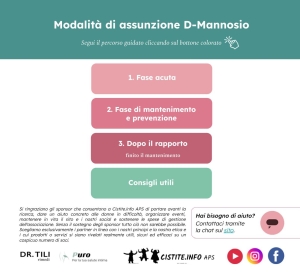
Dosage in acute phase: full-blown cystitis
How should D-mannose be taken during the acute phase of cystitis?
During the acute phase, it is essential to take 6–8 doses of D-mannose per day because it is necessary to ensure the constant presence of this sugar in the bladder to counteract bacterial adhesion to the bladder walls. There is no point in taking large doses (1.5 or 2 grams, for example) only 2 or 3 times a day because once you urinate, the D-mannose will be completely expelled and for many hours the bladder will remain defenceless against bacteria, which will then have the opportunity to attach themselves to the walls and reproduce. Although less convenient, it is better to take “a little, but often” than “a lot, but infrequently”.
Start with a 1g dose of pure D-mannose, followed by another dose an hour later. Continue with a 1g dose every 2-3 hours for a total of 6-8 doses per day for the first 3 days. If the symptoms subside, on the fourth day you can begin to gradually reduce the dose by one dose per day. Once you reach 3 doses, follow the maintenance dosages given in the next chapter. Some people have taken up to 50 grams in a day, but although there are no side effects, such a dosage is wasteful and only risks causing severe bloating.
You can also add 3 grams of D-mannose powder to a 1-litre bottle filled with water and drink it during the morning. Do the same thing in the afternoon. This will ensure constant bladder cleansing and the presence of mannose in the bladder throughout the day. In this case, take 1 gram of mannose before going to bed to protect the bladder during the night. When the symptoms disappear, gradually reduce (by 1 gram every 3 days) the dose of D-mannose that you dissolve in water.
Night-time intake is not necessary, unless you wake up for other reasons and urinate, eliminating the bladder protection provided by D-mannose.
During the acute phase, it is also useful to take a natural anti-inflammatory/painkiller (there are specific natural substances such as lactoferrin, turmeric and piperine, boswellia and bromelain) and a herbal tea made from mallow, horsetail and couch grass.
Further information: Treatment of acute cystitis
Maintenance dosage: prevention of cystitis
How should D-mannose be taken to prevent recurrent cystitis?
After a course of antibiotics, or when you do not have acute cystitis, or after completing two weeks of acute treatment, start with three 1g doses of D-mannose per day: morning, afternoon and evening (before going to bed) for at least one month. You can then gradually reduce the dose to two doses per day for two weeks. At this point, if the symptoms have disappeared, one dose per day (in the evening before bedtime) will be sufficient for another 2 weeks. If the situation remains unchanged (no symptoms), you can stop taking D-mannose and only take it in the event of triggering factors, with the initial dosage continued for only 3 days.
If, for example, sexual intercourse is the trigger for cystitis (as it is for most women), once D-mannose has been suspended, one dose should always be taken immediately after each intercourse and four doses per day for the following 48 hours. At the slightest sign of a flare-up, the dosage should be increased and, if necessary, the dosage for the acute phase should be restarted.
 Receive a free treatment plan for chronic cystitis
Further information: Treatment of chronic recurrent cystitis
‘Another important function of D-Mannose seems to be that of binding to toxins produced by bacteria that can damage the layers of the bladder urothelium, thus acting as a protective agent... Consequently, the use of D-Mannose is increasingly becoming a winning strategy both in prophylaxis and in the treatment of urinary tract infections.’
Taken from "D-Mannose: finally a sugar that is good for you, with no side effects" written by Dr. Emanuela Mistrangelo
Taking D-mannose
How to take D-mannose effectively?
D-mannose must be taken according to a specific dosage schedule. By following these steps, you will ensure maximum effectiveness.
Recommendations for use:
- D-mannose should be taken on an empty stomach as absorption is greater. Therefore, either eat one hour after taking it or take it two hours after a meal. If you are unable to adhere to these times, it is always better to take it on a full stomach than not to take it at all. Less will be absorbed, but a good percentage will certainly reach the bladder, so better a little than nothing.
- Before taking it, you must urinate so that the amount of D-mannose reaching the bladder is not diluted by the urine already present. Drink only one hour after taking it so that the D-mannose remains sufficiently concentrated in the bladder.
- Taking D-mannose with a hot drink (tea, non-acidic herbal teas, hot water, chamomile tea) seems to increase its effectiveness.
- The amount of water with which to take D-mannose is subjective. As a general rule, it should be about 150cc, but this may vary depending on individual bladder capacity. D-mannose must remain in the bladder for at least an hour to allow bacteria to attach to it.
- If you feel a strong urge to urinate within an hour of taking the supplement, it means that you have taken D-mannose with too much water in relation to your bladder capacity, so next time reduce the amount of liquid you take with D-mannose. Conversely, if you still do not feel the urge after 2 hours, it means that you have taken the product with too little water (increase the amount in the next dose until you find the ideal amount that allows you to feel the urge to urinate after about an hour). The amount of liquid with which to take D-mannose varies not only according to bladder capacity, but also according to multiple variables. In summer, for example, we lose a lot of fluids through skin perspiration, so we need to increase the amount of water to ensure a sufficient amount of D-mannose in the bladder. Physical activity increases the loss of body water, so the 150cc of water taken after a long run will only be enough to replenish the fluids lost and will not be eliminated by the kidneys because they are all necessary for the body. Therefore, you may feel the urge to urinate several hours after taking D-mannose, which, incidentally, will not reach the correct concentration/dilution in the bladder. Conversely, cold weather and alcohol inhibit the antidiuretic hormone, increasing urine production. The same thing will happen during cystitis: due to acute inflammation of the urothelium and muscle contracture resulting from pain, bladder capacity is reduced. So in winter, after drinking wine or beer and in cases of acute cystitis, you will probably need to reduce the amount of fluids taken with D-mannose in order to be able to hold them for an hour.
- One hour after taking it, drink plenty of fluids to flush out your bladder so that the D-mannose and everything attached to it is expelled through urination. Unlike what you do during the day, in the evening it is not necessary to urinate one or two hours after taking it. Just let the mannose remain in your bladder and work throughout the night. Why this difference between day and night? Because during the day you will continue to drink, take more D-mannose, dilute your urine and therefore expel bacteria. At night, however, you do not drink, urinate or take D-mannose, so the bacteria present can reproduce undisturbed and unexpelled for 8 hours. So let the mannose keep them at bay by capturing them and preventing them from adhering to the bladder walls. If you wake up during the night for any other reason, take the opportunity to take another dose of D-mannose, especially if you are at the beginning of treatment or if you are in the acute phase.
- Each person has their own risk factors and subjective periods of possible flare-ups. These can include: sexual intercourse, drinking insufficient amounts of water, the premenstrual phase, ovulation, cycling, swimming, periods of high stress, and meals containing certain foods. By increasing your intake of D-mannose during these risky periods or after potentially triggering events, you will be able to prevent recurrence. For example, if your pain usually worsens during the premenstrual period, prevent it by taking 3 doses of mannoside per day during the week before your period. If swimming or cycling exacerbate your symptoms, take D-mannose immediately after swimming or cycling. If cystitis occurs 24-48 hours after sexual intercourse, take it immediately after intercourse and again 3 times in the 24 hours following intercourse.
- Given the frequency with which D-mannose must be taken during the acute phase and the difficulty in adhering to this schedule, you can add the daily amount of D-mannose to a bottle of water that you will drink throughout the day (3 grams in a litre of water to be drunk in the morning and 3 grams in a litre to be drunk in the afternoon). This will ensure a constant presence of mannose in the bladder and constant bladder flushing. We have found that this is as effective as taking mannose every 3 hours.
During the maintenance phase, however, it is better to follow the timing and methods described above.
Where can D-mannose be purchased?
 Thanks to twenty years of experience working with women suffering from urogenital disorders and close collaboration with numerous healthcare professionals and Farmacia Tili, the association Cistite.info APS has developed the Puro line for the well-being and balance of the urogenital tract.
This line includes Puroman, a supplement based on pure D-mannose only, free from excipients, preservatives, binding agents, heavy metals, contaminants, pesticides, solvents, hydrocarbons, allergens, sulphur dioxide, sulphites, colourings, flavourings, allergens and artificial sweeteners. The D-mannose used in Puroman has not been irradiated or ionised and is not derived from GMO or endangered plants.
It is therefore suitable for children, pregnant or breastfeeding women, diabetics, coeliacs and vegans.
Our association has entered into an agreement with Tili Pharmacy, which offers our members a 20% discount.
Discover the agreement with Tili Pharmacy
Bibliography
- D-mannose powder for prophylaxis of recurrent urinary tract infections in women: a randomized clinical trial. Kranjčec B1, Papeš D, Altarac S. Department of Medical Biochemistry, Zabok General Hospital, Zabok, Croatia.