

 IT
IT  DE
DE 
Menopause is the last menstruation in a woman's life.
Cistite.info has developed a specific Care Plan to help you combat and prevent pre-menopause disorders
Menopause
What is menopause?
The average age at which menopause occurs is between 48 and 52 years. It is called early menopause when it occurs before the age of 40 and late menopause when it occurs after 52.
The period following the last menstruation is instead defined as “post-menopause”, characterised by the permanent absence of the menstrual cycle.
It is therefore clear that the term “menopause” is often incorrectly used to refer to what follows the actual menopause, that is, the last menstruation.
“Menopause is truly a retrospective diagnosis: you won’t know you have reached it until you have passed it!”
Christiane Northrup
Menopause is preceded by an adjustment period, which can last from 2 to 10 years, called perimenopause. This period is characterised by an excess of oestrogens and a drop in progesterone, causing a range of typical symptoms: irregular periods, increased menstrual pain, decreased bone density, hot flashes, short but heavy periods, reduced libido, water retention and bloating, weight gain, fat accumulation on the abdomen and hips, cold hands and feet (acrocyanosis), headaches, anxiety, panic attacks, fatigue, insomnia, breast tension, breast pain, night sweats, palpitations, and the appearance or growth of fibroids.
Further reading: Perimenopause
After menopause, on the other hand, the opposite situation occurs, with a marked drop in oestrogens.
Throughout her life, a woman produces three types of oestrogens:
- estriol
- estradiol
- estrone
Their levels vary throughout life. While during the fertile years the main oestrogen secreted is estradiol, in menopause it is replaced by estrone (produced by both the ovaries and body fat), which becomes the predominant hormone as it appears to preserve the health of the heart, brain, and bones, preventing heart disease, senile dementia, and osteoporosis.
Menopause symptoms
What are the symptoms of menopause?
Oestrogen deficiency leads to several typical post-menopause symptoms:
- hot flashes
- night sweats
- vaginal dryness
- irritability
- depression
- confusion
- headaches
- cystitis
- urinary disorders
- vaginitis
- incontinence
- weakening of the vaginal wall
- reduced sexual desire
- decreased collagen in the skin
- peripheral neuropathy
Moreover, the hormonal changes that occur in post-menopause alter body composition, increasing fat mass at the expense of lean mass (muscles, bones, and water). This affects the structure, functioning, and health of our body. Recent studies have found that the greater the fat mass, the higher the incidence of degenerative diseases such as:
- high blood pressure
- heart attacks
- arterial hardening
- type II diabetes
- arthritis
- cancer
Find a doctor specialised in the treatment of menopause disorders, choose from those recommended and affiliated with the association
Further reading: Menopause symptoms
Diagnosis
How to recognise menopause?
The analysis of sex hormones in the blood is of little use because it only indicates the unused hormones, which are therefore released into the bloodstream to be eliminated. To be transported in the circulatory system, these hormones bind to specific proteins that render them inactive. In saliva, however, sex hormones are present free from these proteins and are therefore active. Consequently, salivary hormone analysis is the most reliable, the most economical, the simplest to perform, and unfortunately the least known to most doctors because it is not included in health protocols.
An examination equally reliable as salivary testing is the blood analysis of free (unbound) hormones.
Natural remedies for menopause disorders
What are the natural remedies for menopause disorders?
Although menopause is not a disease, it causes disorders that can be alleviated or eliminated through the administration of oestrogen, which simultaneously prevents the development of degenerative diseases.
The most commonly used hormonal treatment today is hormone replacement therapy (HRT), consisting of synthetic oestrogens or oestrogens extracted from the urine of pregnant mares. These hormones are much more potent than our natural hormones and can cause many side effects:
- nausea
- water retention
- breast tension
- thrombosis
- hypertension
- uterine and breast cancer
- heart attack
- embolism
- stroke
Further reading: Hormone replacement therapy
Bioidentical hormones, on the other hand, have been shown to be able to fill hormonal deficiencies, reducing many post-menopausal disorders without causing the unpleasant effects of synthetic hormones. Bioidentical hormones are extracted from plants and chemically made identical to those produced by humans. For this reason, they are safer than HRT.
Further reading: Bioidentical hormones
Instead of oestrogens (synthetic or bioidentical), it is possible to use phytoestrogens, that is, oestrogens obtained from plants. Although their potency is much lower than that of human oestrogens, they can be a valid and harmless aid in cases of mild symptoms.
Further reading: Useful plants in menopause
It is essential to engage in regular daily physical activity and to include foods rich in calcium, magnesium, vitamin D, and B vitamins in your diet.
To safeguard genital health, it is also necessary to adopt local treatment. Through the experiences shared on the forum over the years, our association has collected many testimonials on various local treatments useful in menopause. Analysing the results obtained, we have formulated a protocol based on products and natural remedies that have so far shown the best balance between benefit and genital irritative effects. The protocol is named after the woman who first experimented with the recommended sequence of products: Dada.
Receive the Dada Protocol against menopause symptoms for free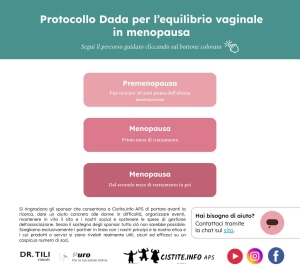
Further reading: The Dada Protocol
Bibliography
- Graziottin, “Menopausa precoce: dal dolore alla salute”, Atti e approfondimenti di farmacologia, Milano, 27 marzo 2015, Fondazione Alessandra Graziottin.
- “Pregnenolone. L'ormone naturale che rallenta l'invecchiamento” , Ascanio Polimeni, Ray Sahelian, Tecniche Nuove 2009
- “Menopausa felice”. Christiane Northrup Urra 2006
- "Risks and benefits of estrogen plus progestin in healthy postmenopausal women: principal results from the Women’s Health Iniziative randomised controlled trial. Writing Group for the Women’s Health Iniziative Investigators". JAMA 2002; 288: 321-33.
- "Effects of conjugated equine estrogen in ostmenopausal women with hysterectomy" The Women’s Health Initiative randomized controlled trial. JAMA 2004;291: 1701-12.
- "Conjugated equine estrogens and incidence of probable dementia and mild cognitive impairment in postmenopausal women: Women’s Health Initiative Memory Study". JAMA 2004; 291: 2947-58.
- "Espeland MA, et al. Conjugated equine estrogens and global cognitive function in postmenopausal women: Women’s Health Initiative Memory Study". Shumaker SA, et al. JAMA 2004; 291: 2959-68.
- "Estrogen and dementia: insights from the Women’s Health Initiative Memory Study". Schneider LS. JAMA 2004; 291: 3005-7.
- “Risks and Benefits of Estrogen Plus Progestin in Healthy Postmenopausal WomenPrincipal Results From the Women's Health Initiative Randomized Controlled Trial” Writing Group for the Women's Health Initiative Investigators, JAMA. 2002;288(3):321-333.
- “Prevention and treatment of venous thromboembolism during HRT: current perspectives”, Hannelore Rott. Int J Gen Med. 2014; 7: 433–440.
- “Menopausa: vivere bene il cambiamento”, Canino, Vozzella, Diunti Demetra 2016.
- “The effects of compounded bioidentical transdermal hormone therapy on hemostatic, inflammatory, immune factors; cardiovascular biomarkers; quality-of-life measures; and health outcomes in perimenopausal and postmenopausal women”. Stephenson K1, Neuenschwander PF, Kurdowska AK.Int J Pharm Compd. 2013 Jan-Feb;17(1):74-85
- ”Cellular and Molecular Biology of Candida albicans Estrogen Response" Georgina Cheng, Kathleen M. Yeater, and Lois L. Hoyer, 2006, American Society for Microbiology
- “The Women's Health Initiative trial and related studies: 10 years later: a clinician's view.” Gurney EP1, Nachtigall MJ1, Nachtigall LE1, Naftolin F2,J Steroid Biochem Mol Biol. 2014 Jul;142:4-11. doi: 10.1016/j.jsbmb.2013.10.009. Epub 2013 Oct 27.